

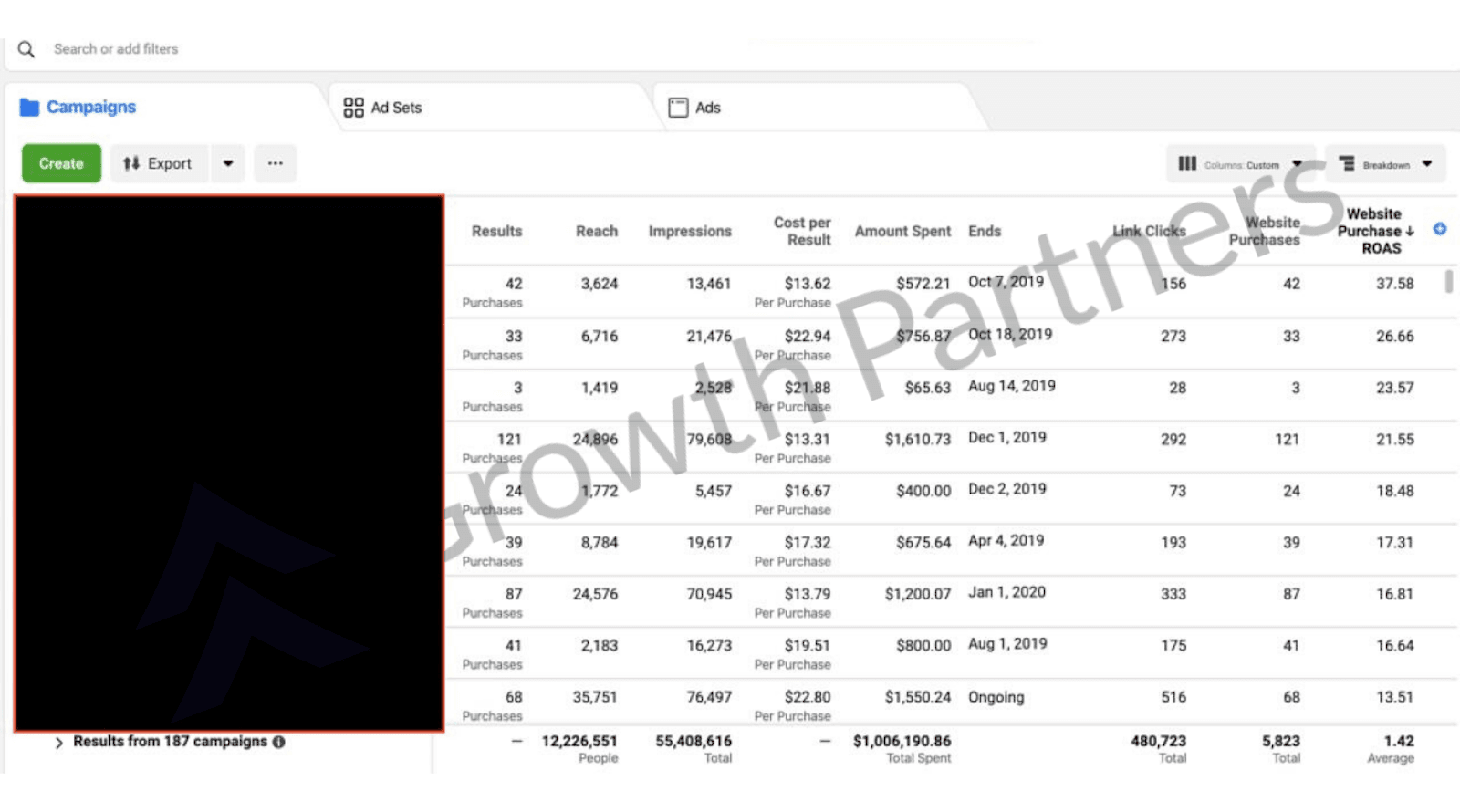
$1.5M in Facebook spend managed in a year at 2.8X backend ROAS.
Heather Delaney Reese runs a US/Canada travel-blogging education brand — helping people launch and grow their own blogging businesses. It became the biggest single account we've ever managed, around $150K a month on Meta. The front-end target was just 0.8X ROAS; we delivered 1.4X on the ad front and 2.8X across the funnel, while building a 120K+ subscriber list as a durable asset.
$1.5M
Ad spend managed in 12 months
1.4X
Front-end ROAS (vs 0.8X target)
2.8X
Backend ROAS incl. upsells
120K+
Email subscribers built
The challenge
Scaling a single account past $150K a month
Heather's brand runs on a free front-end offer feeding monthly launches, so paid traffic has to stay both cheap and consistent. When they came to us, that consistency was the missing piece — spend and results weren't stable enough to scale the funnel.
The funnel also had a structural quirk: buyers took ~14 days on average to convert, so any change took two weeks to read. At $3,500–4,000 a day, that's half a month and half the budget spent before you know whether something worked.
The goals they couldn't reach alone
Challenges faced
Growth had plateaued before us
Spend and results weren't consistent enough to scale the funnel with confidence.
A 14-day conversion window
It took ~14 days to know if a change worked — half a month and half the budget gone before you could read the result.
Front-end ROAS looked 'low'
A 0.8X target confuses people, but the front end is designed to break even; the profit lives in the launches and the list.
Ad fatigue hits faster at scale
The more you spend, the quicker audiences see the same ad — frequency climbs and performance decays.
The approach
Segment the retargeting, open new markets, scale the budget with discipline
The account didn't need reinvention — it needed disciplined scale. We rebuilt retargeting around tight segments, opened new markets once the core was stable, and added budget only where performance was already proven.
Retargeting segmentation
The single biggest lever on the account. Instead of one broad retargeting pool, we split audiences into tight segments by funnel stage and engagement, so warm buyers, cold signups and past purchasers each saw the right message at the right time.
$500 → $45K
One segmented retargeting promo
Expansion into new markets
With the USA and Canada core stable and profitable, we opened new English-speaking markets to widen the audience and keep acquisition costs from climbing as spend grew.
New geos
Scaled beyond USA & Canada
Disciplined budget scaling
We scaled spend to roughly $150K a month, adding budget only on top of proven, stable winners — never by pushing a good campaign back into the learning phase.
~$150K/mo
Spend scaled to
Why 1.4X ROAS was the real win
A 1.4X front-end ROAS sounds modest until you understand how this funnel actually makes money.
The front end is built to break even
The job of the front-end campaign is to recover ad cost, not to print profit. Every dollar that comes back on the front lets you acquire a buyer for free.
Long windows under-attribute sales
With a 14-day conversion lag, the ad manager never sees every sale it caused. Experience showed 0.8X was the honest breakeven target — and we cleared it by 75%.
The profit is in the launches
Front-end ROAS was 1.4X; across the funnel, including the monthly launches, it was 2.8X. Judge the funnel, not the campaign screenshot.
The results
The numbers behind a $1.5M year
Twelve months on Meta, one flagship account — and an audience asset that keeps paying back.
$1.5M
Managed in 12 months, profitably
$500 → $45K
One retargeting promo to the list
$100–120
Target CPA held
~$150K
Peak monthly spend
The receipts
Straight from the ad accounts.
“I would rather not touch a good-performing campaign until I have a solid tested, proven and consistent insight for the account. When you edit a winner, you push it back into the learning phase — and it rarely returns to where it was.”
Growth Partners
What you can learn
How this applies to your business
Don't fix what's already working
Most buyers keep editing a winning campaign chasing a higher ROAS — and push it straight back into the learning phase, where it rarely recovers. For scale you need stability over a marginally higher return. Protect winners; run every test on a separate 10–20% budget sleeve.
Under long conversion windows, optimize leading indicators
A 14-day lag means waiting to read CPA burns half the month. Back-work your target CPA into signup cost, CPC, page views and engagement, then manage those daily. If the front-end metrics stay in range, the CPA follows.
The list is the real asset
A year of ads built 120K+ subscribers. A single $500 retargeting-plus-email promotion to that list returned $45K. Front-end ROAS badly undersells the compounding value of an audience you own — look at the big picture, not the short-term screenshot.
Never let one channel own you
A 36-hour Facebook ad rejection once forced a launch to be postponed — the moment the brand felt how dependent it had become. Scale your winning channel hard, but always be building a backup before you need it.
Spending big and scared to touch it?
We manage seven-figure accounts the boring, profitable way — protecting winners, reading the funnel, and building the asset underneath. Let's talk about scaling yours.