

How to Advertise on YouTube Without Wasting Budget
A practitioner's walkthrough of how to run YouTube ads in India — what you need before you start, how campaign setup actually goes, how targeting differs from Meta, what budget is realistic, and what the first few weeks look like. Plus a straight answer for creators, who need something different from what this post mostly covers.
By Bharathidasan Moorthi

Two completely different people search for how to advertise on YouTube, and most guides are written as though only one of them exists. The first is a creator who wants more people to watch a video they made. The second is a business owner who wants YouTube to produce leads or sales.
They need different campaigns, different settings, and different definitions of success, and advice written for one is close to useless for the other. So the first section sorts that out. Everything after it is for the business advertiser, because that is where the money and the mistakes are.
If you have not settled on a format yet, the format comparison is the faster place to start.
First: are you promoting a video, or selling something?
These are two different jobs. A creator promoting a video is buying views; a business is buying a conversion, and almost every setting after that first choice follows from it.
If you are a creator who wants views on a video, you can buy them. Start from YouTube Studio, which pushes you into a simplified Google Ads flow, or build it properly in Google Ads as a campaign optimising for views. Your ad is your video, and you will get views plus some subscribers.
Paid promotion is genuinely useful for a launch, a trailer, or early distribution on a video you believe in. It is not a shortcut to monetisation.
| What changes | Creator promoting a video | Business buying media |
|---|---|---|
| Optimise for | Views, kept cheap | A conversion, tracked properly |
| What you get | Views and some subscribers | Leads or sales you can attribute |
| Judge it on | Cost per view | Cost per lead or cost per sale |
| Monetisation | No progress toward the watch hours threshold | Not the point |
What you need before you open Google Ads
Four things need to exist before you open Google Ads: a billing-enabled account, a linked YouTube channel with the video on it, a video built for direct response, and conversion tracking you have tested. Most first YouTube campaigns fail during setup, not in the auction, and skipping any of the four costs you the first month.
A Google Ads account with billing set up
YouTube advertising runs through Google Ads — there is no separate YouTube ads platform. In India that means a payment method plus GST details entered correctly, since invoices and input credit depend on it.
A YouTube channel with the video on it
The video needs to be uploaded to a channel, public or unlisted — unlisted is common for ads you do not want cluttering your channel. Link the channel to your Google Ads account, because several features, including building audiences from people who engaged with your channel, depend on that link.
A video built for the first five seconds
This is the part people underestimate. A repurposed brand film does not work as a direct-response ad. You need something that states what you sell and who it is for inside the first five seconds, because on skippable in-stream that is the whole window before the viewer decides.
Conversion tracking that actually fires
Not GA4 sessions — a conversion action in Google Ads, firing on the event that matters, tested end to end before you spend a rupee. Running YouTube without tested tracking is the most common reason accounts conclude the channel does not work.
How to run YouTube ads: the actual setup
With those four in place, the build is not complicated, and the menu labels move around more than the underlying choices do. It runs in six decisions, in this order.
- 1
Pick the objective
Sales, leads, awareness, or no objective at all, which unlocks every setting rather than a filtered subset. For a first conversion campaign, reviewing settings manually beats the guided flow, which hides options you will want.
- 2
Choose the campaign type
Video campaigns carry the classic in-stream and reach formats. Demand Gen has absorbed the in-feed and discovery-style placements along with Shorts and Discover inventory, and is where much of what used to be TrueView Discovery now lives. Performance Max serves YouTube too, but as one channel inside a black box — a poor place to learn whether YouTube works for you.
- 3
Set the bid strategy
This is where the real decision sits. Optimising toward conversions hands pacing to the system and needs conversion data to work with. Optimising toward views or impressions gives you control, cheap volume, and no conversions to speak of. If you have tracking and any conversion history, bid toward conversions. If you have neither, you are not ready for a conversion campaign yet.
- 4
Set budget, schedule, locations and languages
Set language deliberately rather than leaving the default. If you are targeting specific states or cities, check the option controlling whether you reach people in the location or merely interested in it — that setting quietly spends budget outside your market in a lot of accounts we audit.
- 5
Build the targeting
Audiences first, content placements second. This is the menu where YouTube diverges most sharply from other platforms, and it is worth understanding before you start ticking boxes.
- 6
Build the ad
Video URL, final URL, headline, description and call to action.
How YouTube targeting differs from Meta
The core difference is search. YouTube sits on top of Google, so you can target people by what they have looked for, and Meta has no real equivalent. If your paid experience is Meta, this is where the mental model has to change, and it is why Meta-fluent buyers often underperform on YouTube for a month.
Meta works primarily by letting the delivery system find people who behave like your converters — you give it a conversion event and broad parameters and it does the identification. Interest targeting exists there, but it is increasingly a suggestion rather than a lever.
| Lever | Meta | YouTube |
|---|---|---|
| How the audience is found | The delivery system finds people who behave like your converters | You choose the segments, and search behaviour is one of them |
| Search intent | No real equivalent | Custom audience segments built from search terms — the closest thing on the platform to search intent |
| Interest and life stage | Present, but increasingly a suggestion rather than a lever | In-market, affinity, life events, detailed demographics, plus your own remarketing lists |
| Content targeting | Nothing like it | Specific YouTube channels, videos, topics, or keywords about the content being watched |
The most reliable starting point for an Indian account with existing customers is remarketing plus a custom segment built from the search terms your Search campaigns already convert on. You are advertising to demand you have proven exists.
What budget is realistic in India
We will not quote a universal number, because the honest answer depends on your target cost per acquisition. But one structural rule holds regardless of category: automated bidding needs conversion volume to stabilise.
The commonly cited rule of thumb is a daily budget of roughly ten times your target CPA, so the campaign produces enough conversions in a week for the system to learn from rather than guess. If your target CPA is ₹500, a ₹300 daily budget is not a small test — it is a campaign that will never gather enough data to work, and it will read as failure.
That is the most common budgeting mistake we see on Indian accounts: splitting a modest monthly budget across four campaigns so none of them accumulates signal, then concluding YouTube is expensive.
One campaign with a real budget beats four starved ones.
YouTube inventory in India is cheap relative to Western markets, so a given budget buys far more impressions here. The constraint is rarely reach — it is conversion volume. Plan for a testing period rather than a test: six to eight weeks before any keep-or-kill decision.
How to judge it: attribution is the hard part
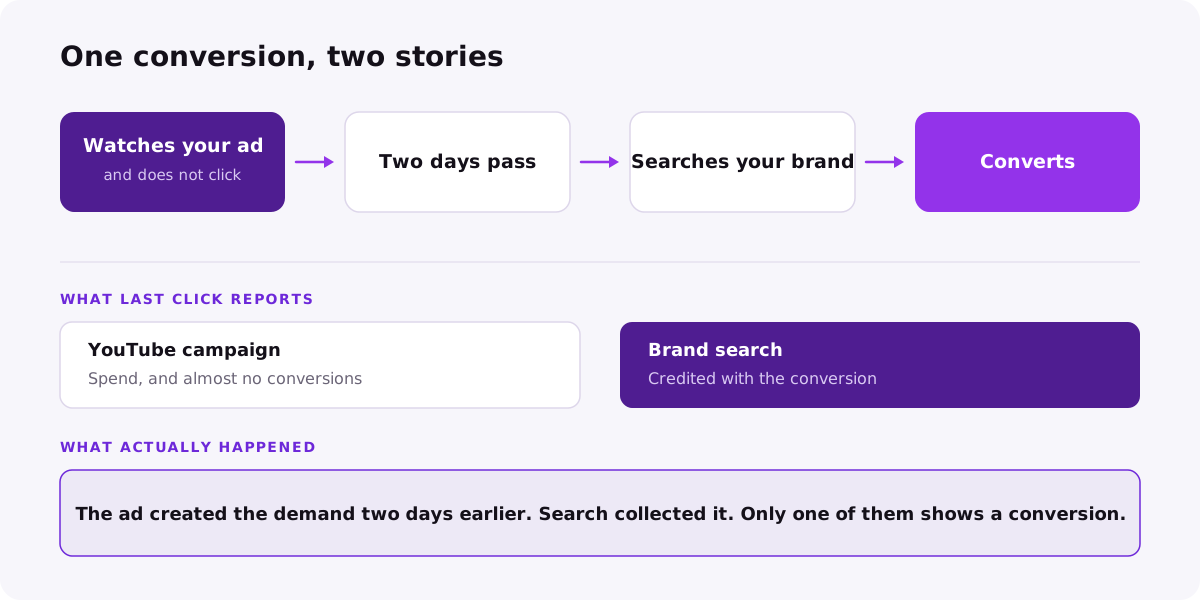
YouTube almost never looks good in a last-click report, and this trips up more advertisers than any targeting mistake. Someone watches your ad, does not click, searches your brand two days later, and converts through Search or direct.
Last-click credits Search. The YouTube campaign shows spend and a handful of conversions, and gets paused — while branded search volume has gone up and nobody connected the two.
What to look at instead
Look at the view-through and engaged-view conversion columns alongside click conversions, since they exist to capture exactly this behaviour. Confirm the current definitions and lookback windows in the interface rather than assuming them.
Then watch branded search volume and blended cost per acquisition across the whole account before and during the test. If blended CAC improves while YouTube's own reported CPA looks mediocre, the campaign is probably working. This is not an argument for ignoring numbers, it is an argument for looking at the right ones.
What the first few weeks actually look like
The first few weeks look worse than the campaign is. Three things are predictable, and each one causes damage when it arrives as a surprise.
Week one will be noisy and expensive
Bidding recalibrates whenever you change budget, targets, targeting or creative, so the fastest way to guarantee a bad month is to adjust something every day because day three looked bad. Leave it alone for seven to ten days unless something is clearly broken. Then review, make one meaningful change, and give it another week.
Cost per conversion will be worse than branded search
That is not failure. Branded search harvests demand that already exists; YouTube is creating it. Judging both against the same CPA target will always kill the channel doing the harder job.
Creative will be the biggest lever by a wide margin
Once tracking is right and the campaign has budget to breathe, the difference between working and not working is almost always the first five seconds of the video, not a targeting setting. If a campaign underperforms after two weeks with clean tracking, change the ad before you change the audience.
The mistakes that waste the most money
- Launching before conversion tracking is tested end to end, leaving no way to evaluate the result
- Running a brand film as a direct-response ad, with the offer buried at second twenty
- Splitting a small budget across several campaigns so none gathers enough conversion data to optimise
- Layering audience, placement, keyword and demographic targeting together until delivery chokes
- Judging YouTube on last-click conversions while branded search quietly absorbs the credit
- Leaving the location setting on presence-or-interest and paying to reach people outside your market
- Editing budgets and targets every few days and resetting the learning each time
What we would do with a first YouTube budget
If an Indian business asked us how to run video ads on YouTube with a modest budget and no prior history, this is the sequence.
- 1Fix tracking, and verify it with a real test conversion
- 2Build one skippable in-stream campaign optimising toward your primary conversion, with the full budget behind it rather than split
- 3Target remarketing plus one custom segment built from the search terms your Search campaigns already convert on — proven demand, not speculative interest
- 4Make one video that states the offer inside five seconds, pointed at a landing page built for that offer rather than your homepage
- 5Leave it running for two weeks before you read anything into it
Then read the account level rather than the campaign level: total conversions, blended cost per acquisition, branded search volume. If the business improved, scale the budget and add a second creative angle. If nothing moved, replace the video before you touch anything else.
None of this is complicated. It is just done in the wrong order in most accounts — tracking last, creative last, budget spread thin, and a verdict reached in week one.
Common questions
Do I need existing Google Search campaigns before I run YouTube ads?
No, but the starting point recommended here assumes them. The strongest first targeting layer is a custom segment built from the search terms your own Search campaigns already convert on, and without that history you are guessing at which terms signal intent rather than reading it from your own data. If you have no Search history, lean on remarketing lists first, expect the early weeks to be noisier, and build the search-term segment once you have data of your own to draw from.
What if my target cost per acquisition makes the recommended daily budget unaffordable?
Then YouTube prospecting is probably not the right first channel, and that is the most useful thing the ten-times rule of thumb tells you. A budget too small to produce steady weekly conversions will not let automated bidding stabilise, so the campaign reads as a failed channel test when it was really an underpowered one. The realistic options are to concentrate everything into a single campaign rather than splitting it, or to keep spending where demand already exists until the budget can support a real test.
Want someone to run this for you?
We plan, build, and manage YouTube ad campaigns end to end — formats, targeting, creative, and retargeting. Google Premier Partner.
See our YouTube advertising services