


YouTube Ad Formats Explained: When to Use Each One
Skippable, non-skippable, bumper, in-feed, Shorts, and masthead — what each format costs, what it's good at, and how to stop picking one by default.
By Bharathidasan Moorthi

Most YouTube campaigns we audit are running one ad format. Not because someone compared the options, but because that is what the campaign type defaulted to when it was built. The creative gets iterated on for months while the format never gets revisited — the format that decides how you are billed, how long you get to hold attention, and whether a viewer can leave after five seconds.
That is an expensive default. A six-second bumper and a two-minute skippable in-stream ad are not the same lever with a different runtime. They are billed differently, they suit different objectives, and they fail in different ways.
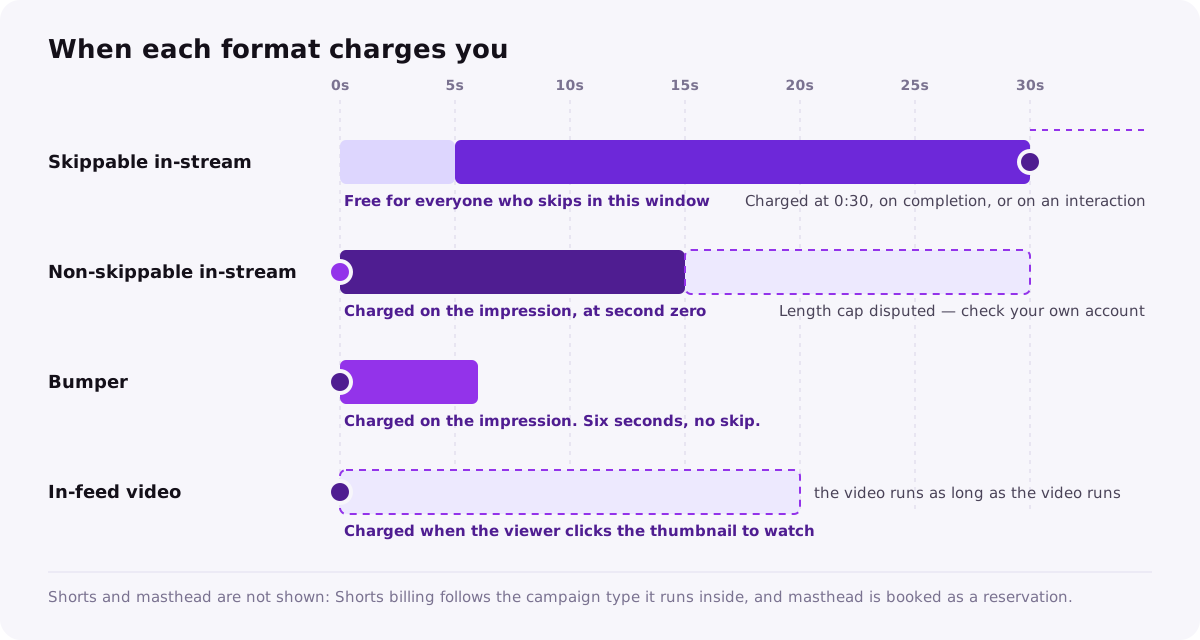
Here is what each YouTube ad format actually does, what it costs, and when it earns its place in the plan. If you are starting further back than this, the setup walkthrough covers what needs to be in place before format choice matters at all.
The six YouTube ad formats at a glance
YouTube sells six ad formats. Five of them you can build yourself inside Google Ads. The sixth is reservation-only and does not appear in the interface at all.
| Format | How you are billed | Best at | What kills it |
|---|---|---|---|
| Skippable in-stream | Usually CPV — skips before 30 seconds are typically free | Conversions, lead generation, webinar registrations, considered purchases | Burying the hook. If the offer is not clear by second four, you are paying for the wrong viewers |
| Non-skippable in-stream | CPM — you pay for every impression | Awareness, launches, time-boxed offers, frequency against a defined audience | Using it for conversions. Guaranteed views are not qualified views |
| Bumper | CPM | Retargeting, reach top-ups, frequency, single-idea reminders | Trying to fit a full pitch into six seconds |
| In-feed video | You pay on the click to watch | Demos, tutorials, comparisons, capturing existing search intent | A weak thumbnail and headline. They do all the work here, not the video |
| Shorts | Varies with the campaign type it runs inside | E-commerce, app installs, top-of-funnel reach, anyone already producing Reels creative | Repurposing horizontal assets — the single most common reason Shorts campaigns underperform |
| Masthead | Reservation only — CPM or cost per hour, booked through Google | National brand launches with budget to match | The budget, for almost every advertiser |
Skippable in-stream ads
Skippable in-stream is the format most people picture when they think of YouTube advertising. Your ad plays before, during, or after a video, and the viewer can skip after five seconds.
You are generally billed on a cost-per-view basis — you pay when someone watches 30 seconds, watches the full ad if it is shorter than 30 seconds, or interacts with it. People who skip at five seconds usually cost you nothing. Depending on the campaign type and bidding strategy you choose, this can also run on a CPM or target-CPA basis.
Use it when you have something to explain: a considered purchase, a webinar, a high-ticket service, anything where the decision needs more than a slogan. It is the workhorse format for direct response on YouTube.
There is no hard length cap, but performance drops off sharply past two minutes for most direct-response offers. If you are weighing it against the forced-completion alternative, the skip decision has its own trade-offs.
Non-skippable in-stream ads
Non-skippable in-stream is the same placement with no escape hatch. The viewer watches the whole thing before the video they came for.
Billing is CPM: you pay per thousand impressions, whether the message landed or not. That is the trade. You are buying guaranteed completion instead of self-selected attention, and you are paying for everyone.
It works when the message is genuinely short and the goal is recall rather than response — a launch, a sale window, a category message you need drilled in. It works badly as a direct-response format, because a captive audience is not the same as an interested one. Forcing a 15-second pitch on someone who would have skipped at five does not make them a better prospect. It makes them a more annoyed one.
Bumper ads
A bumper is six seconds, non-skippable, billed on CPM. It is the tightest format YouTube offers and the most misunderstood.
Six seconds is not enough to explain anything. It is enough to land exactly one idea — a price, a name, a single visual. Treat it as a reminder rather than an argument.
The strongest use we see is not standalone. It is as the second touch: run a skippable in-stream ad to carry the actual message, then retarget the people who watched with bumpers to keep the brand present at very low cost. Frequency without fatigue, because six seconds is too short to irritate anyone.
Bumpers are also the cheapest way to add reach to a campaign that has plateaued, since the CPM is typically well below in-stream. If the idea needs a sentence of setup, it is the wrong format — what actually fits in six seconds is a narrower list than most teams expect.
In-feed video ads (what used to be called Discovery)
In-feed video ads do not interrupt anything. Your video appears as a thumbnail and headline in YouTube search results, alongside related videos, or on the home feed — and the viewer chooses to click it.
You pay when someone clicks through to watch. That self-selection makes the traffic qualitatively different from in-stream: nobody landed on your video by accident, so watch times and engagement tend to be substantially higher.
If you have seen the term TrueView, this is part of what it referred to. Google has largely retired that branding in favour of plainer names — skippable in-stream and in-feed video ads — and the in-feed placements now sit primarily inside Demand Gen campaigns. The format did not disappear; the label did.
It suits content that someone would plausibly search for: demos, comparisons, tutorials, case studies. It suits a hard-sell pitch poorly, because the thumbnail and the headline have to earn the click on their own merits before the video gets a chance.
YouTube Shorts ads
Shorts ads are vertical and full-screen, served between Shorts as the viewer swipes. It is the fastest-growing inventory on the platform and, for now, some of the cheapest attention available.
There is a real opportunity in the gap. Because Shorts inventory is newer, competition is thinner than on in-stream. Advertisers who already produce vertical creative for Instagram Reels are sitting on assets that work here with minimal adaptation, and many of them have not thought to use them.
It is the natural home for e-commerce and app installs, and for top-of-funnel reach generally. The full Shorts guide covers the vertical specs and the safe zones the interface takes from you.
Masthead
The masthead is the banner across the top of the YouTube home feed. Enormous reach, and not something you can buy in the interface — it is reservation-only through a Google sales representative, typically sold on a cost-per-thousand-impressions or cost-per-hour basis.
It is a brand-launch instrument at national scale, and the budget reflects that. For almost every advertiser reading this it is not a realistic option, and that is fine. We are including it because people search for it and then spend a while trying to find it in Google Ads, where it does not exist.
Which format for which objective
| Your objective | Lead format | What supports it |
|---|---|---|
| Conversions and leads | Skippable in-stream | In-feed second, bumpers for retargeting |
| Launch or awareness | Non-skippable, carrying the message | Bumpers for frequency |
| Cheap incremental reach | Shorts | Bumpers |
| Capturing existing intent | In-feed video ads | The thumbnail and headline do the work |
| Retargeting warm viewers | Bumpers | Then skippable in-stream with a different angle |
| A national brand moment | Masthead, if the budget is genuinely there | Everything else, underneath it |
The four mistakes we see most
- Running one format because it was the campaign default, and never testing a second
- Using non-skippable for conversion campaigns — forced completion is not interest
- Letterboxing horizontal creative into Shorts and concluding that Shorts does not work
- Judging every format on cost per view. A bumper and an in-stream ad are not doing the same job, so the same metric cannot rank them
What we usually run
For most Indian accounts we start with skippable in-stream carrying the real message, because it is the only format that lets you both qualify the audience and hold them long enough to explain something. Once there is a pool of people who watched, bumpers and Shorts do the retargeting work at a fraction of the cost.
In-feed comes in when there is genuine search demand for the topic. It is a very different lever, closer to search advertising than to display, and it is underused.
Formats are one input. Targeting, creative, and what happens after the click matter at least as much. But choosing the format deliberately instead of inheriting it is one of the cheapest improvements available on a YouTube account, and it takes an afternoon. If you would rather hand the afternoon to someone else, that is what we do.
Common questions
Do I pick the ad format, or does the campaign type pick it for me?
You do not choose a format from a menu. You choose a campaign type and an objective, and the formats you are eligible to serve follow from that choice, which is why so many accounts end up running whatever the default was. Google renames and reshuffles YouTube campaign types regularly, so check what the current options are inside your own account rather than working from a list in an article. The useful discipline is to decide which format you want first, then find the campaign type that gets you there.
What do YouTube ads cost in India?
This article deliberately does not quote a CPV or a CPM, because a real figure depends on the audience you target, how many other advertisers want that audience, the season, and how good the creative is. Anyone quoting you a single national number is guessing. What is stable is the relative ordering: bumper CPMs typically sit well below in-stream, and Shorts inventory is currently among the cheapest attention on the platform.
Want someone to run this for you?
We plan, build, and manage YouTube ad campaigns end to end — formats, targeting, creative, and retargeting. Google Premier Partner.
See our YouTube advertising services