


YouTube Bumper Ads: Specs, Examples, Strategy
A bumper ad is a six-second, non-skippable YouTube video ad billed on CPM. The full specs, the patterns that work in six seconds, and why bumpers earn their money as a second touch rather than a standalone campaign.
By Bharathidasan Moorthi

A bumper ad is a six-second, non-skippable YouTube video ad, billed on a cost-per-thousand-impressions basis. It plays before, during, or after the video the viewer came for, and there is no skip button. Six seconds is a hard cap, not a guideline.
That is the whole format. It is the tightest thing YouTube sells and the most consistently misused, because the constraint tempts people into the exact thing it forbids: explaining something.
Six seconds is not enough to explain anything. It is enough to land exactly one idea.
Below are the specs, the patterns that actually work inside that limit, and the campaign role where bumpers stop being a novelty and start earning their cost. If you are still deciding which YouTube format belongs in the plan at all, start with the format comparison.
Bumper ad specs
There are two layers to the specs. The format rules are set by the ad type. The file rules are set by YouTube, because a bumper ad is just a YouTube video that a campaign points at.
| Spec | What to use | Why it matters |
|---|---|---|
| Length | Six seconds maximum | Ads longer than six seconds are not eligible to run as bumpers |
| Skippability | None | The viewer watches all six seconds |
| Billing | CPM | You pay per thousand impressions, not per view or per click |
| Aspect ratios | 16:9 standard, with 1:1 and 9:16 also supported | Supplying more than one ratio lets the ad fill the screen properly across devices |
| Resolution | 1920 x 1080 for 16:9, 1080 x 1080 for square, 1080 x 1920 for vertical | Do not go near the minimum accepted resolution even where a lower file is allowed. Anything below the recommended sizes looks cheap on a modern phone screen |
| File format | MP4 with H.264 video and AAC audio | The safe encode. YouTube accepts a wide range of formats and transcodes on ingest |
| Frame rate | Match your source, typically 24 to 60 frames per second | No conversion step means no motion artefacts introduced on the way in |
| Hosting | Public or unlisted on a YouTube channel | The video must be live on a channel before a campaign can use it |
| Audio | Designed, not an afterthought | Not technically mandatory, but a bumper without sound design is throwing away one of its two channels |
YouTube bumper ad size: which ratio to supply
The question behind 'bumper ad size' is usually not about file weight. It is about which shape to cut.
Cut 16:9 as the master, because it covers desktop, television screens, and standard mobile in-stream. Then decide whether a vertical cut is worth it based on where your audience watches. If your traffic is overwhelmingly mobile, which it is for most Indian consumer accounts, a 9:16 or 1:1 version stops your ad from sitting in a small letterboxed strip on a phone held upright — the same letterboxing that quietly sinks vertical campaigns on Shorts.
What makes a six-second ad work
The failure mode is always the same: a compressed version of a thirty-second script. Logo, setup, claim, offer, logo. Nothing lands because five things were attempted.
A bumper that works commits to one idea and repeats it visually. Treat it as a reminder rather than an argument. In practice that means three things:
- Start mid-action, with no establishing shot
- Use no more than two or three cuts
- Put the brand on screen in the first second, rather than saving it for a reveal at the end
It also means writing for a viewer who is mildly annoyed. They are waiting for the video they came for. A bumper that is quick, clear, and slightly enjoyable gets tolerated. A bumper that is loud and dense gets resented, and resentment attaches to the brand.
Bumper ad examples: five patterns that hold up
Rather than naming brands whose campaigns you cannot inspect, here are the structural patterns that repeatedly work inside six seconds. Each one solves the format's core problem differently, and each is buildable from footage you likely already have.
| Pattern | What it is | Why it works |
|---|---|---|
| The single number | One price, one discount, one delivery time, held on screen with the brand. No claim, no reasoning | A number is the only kind of argument that survives six seconds |
| The one-line proposition | A short spoken or written sentence that states what the product is for, with a single supporting visual | It fits when the category is unfamiliar and the job is comprehension rather than persuasion |
| The visual gag | A quick sight joke that ends on the brand | It earns attention rather than demanding it, and it is one of the few things people will happily rewatch |
| The date or deadline | A launch date, a sale window, a match day | Urgency needs no setup and the viewer already understands the format |
| The recognition cue | A recut of the most distinctive three seconds from your longer ad, running against people who have already seen it | You are not communicating a new idea, you are reactivating one that has already been paid for |
How bumper ads are bought
Bumpers are bought as a video ad format inside a YouTube campaign, typically one built around reach, awareness, or frequency objectives, and bid on a CPM basis. Google renames its campaign types often, so the safest way to think about it is by billing model rather than menu label: if the campaign is buying impressions rather than views or actions, bumpers belong in it.
Bumper CPMs are typically well below in-stream. That is the practical reason they exist in a plan at all, and it is what makes the strategy below work.
Where bumpers actually earn their money
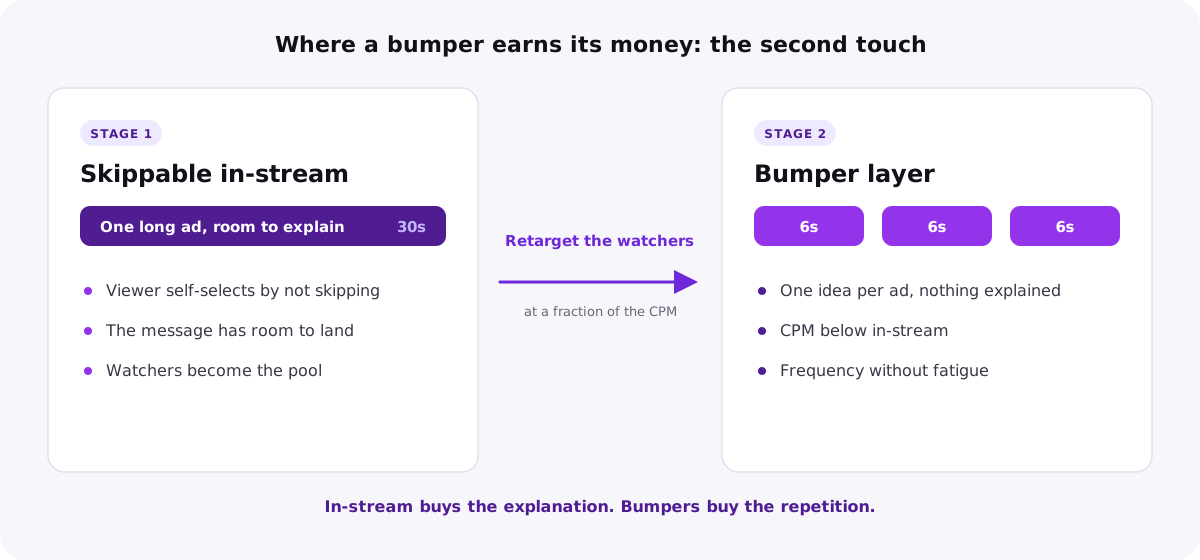
Bumpers are weak standalone and strong as a second touch. That is the single most useful thing to understand about the format.
As cold-traffic prospecting, it is a stretch
Run as a cold-traffic prospecting format, a bumper is asking six seconds to introduce a brand to someone who has never encountered it. That is a lot to ask, and the results usually reflect it. The audience that saw the ad cannot tell you what it was for.
As a retargeting layer, the arithmetic changes
Carry the actual message in a skippable in-stream ad, where the viewer has self-selected and you have the room to explain something. Then retarget the people who watched with bumpers. Now the six seconds are not introducing anything. They are re-lighting a message that has already landed, against an audience that recognises it, at a fraction of the in-stream CPM.
You are buying frequency at low cost without buying fatigue, because six seconds is too short to irritate anyone. The same repetition delivered through a thirty-second in-stream ad would burn the audience out in a week.
As cheap incremental reach on a plateau
The second use worth having is as cheap incremental reach on a campaign that has plateaued. When in-stream delivery flattens because the good inventory is exhausted at your bid, a bumper layer adds impressions at a materially lower cost per thousand. It will not carry a new argument, but it will keep a brand present through a launch or a season.
How to judge a bumper campaign
The most common analytical mistake is ranking a bumper against an in-stream ad on cost per view or cost per conversion. They are not doing the same job, so the same metric cannot rank them.
Judge them on what they are actually buying:
- Reach and frequency against the specific audience you targeted, not against the whole campaign
- Cost per thousand impressions relative to your in-stream CPM, which is the arbitrage you are exploiting
- Change in conversion rate or search volume within the retargeted pool while the bumper layer is running, versus a period when it is not
- Brand lift measurement if your spend qualifies for it, since eligibility depends on minimum budget thresholds that are worth checking before you plan around them
- Whether the primary in-stream campaign improves when the bumper layer is switched on and off, which is a crude but honest incrementality read
When not to use bumpers
- As your only YouTube format. There is no version of a six-second ad that both explains and converts
- For anything that needs a sentence of setup. If the idea does not survive being stated flat, it is the wrong format
- As a compressed edit of a longer ad. A thirty-second script cut to six seconds is five ideas at quarter clarity
- For a considered purchase on cold traffic, where the viewer has no context to attach the six seconds to
- When you have no retargeting pool yet. Build the pool with a longer format first, then add bumpers to it
What we would actually run
- 1
Let skippable in-stream carry the message
Skippable in-stream carries the message and builds the audience. It is the only format that lets you both qualify a viewer and hold them long enough to explain something.
- 2
Run bumpers against the audience it built
Bumpers then run against that audience, on a CPM bid, with a single idea each and a vertical cut supplied alongside the horizontal master. Two or three variants rather than one, so the same six seconds do not repeat identically for weeks.
- 3
Add a reach line only when reach is the point
If there is a launch, a sale window, or a season where reach matters more than depth, bumpers get a separate reach-focused line to add frequency cheaply for the duration and then come off.
The whole format takes an afternoon to produce properly and most advertisers either ignore it or ask it to do a job it structurally cannot do. Used as a second touch, it is one of the cheapest ways to make a YouTube campaign that is already working, work harder.
Common questions
What do YouTube bumper ads cost?
We will not quote you a CPM, and the article deliberately does not either. Bumper CPMs move with your vertical, how wide the targeting is, the season, and how much competition there is for the same audience, so a figure taken from someone else's account is worth very little in yours. What holds is the relationship rather than the number: bumpers clear below in-stream in most accounts we see, which is the whole reason they belong in a plan. The benchmark worth having is your own in-stream CPM, measured in the same account over the same weeks.
Are bumper ads worth it on a small budget?
Usually not as your first YouTube spend. Bumpers only pay off when there is already an audience to retarget, which means a longer format has to run first and accumulate viewers. If the budget is small enough that it can only fund one format, put it into skippable in-stream, where the viewer self-selects and you are billed for attention people chose to give. Add the bumper layer once the pool exists and the primary campaign is stable enough that you can tell whether switching the layer on changes anything.
Want someone to run this for you?
We plan, build, and manage YouTube ad campaigns end to end — formats, targeting, creative, and retargeting. Google Premier Partner.
See our YouTube advertising services