


Skippable vs Non-Skippable YouTube Ads
The skip button is not the real difference between the two formats. The billing model is. Skippable ads charge you for attention people chose to give; non-skippable ads charge you for everyone. That decides which one belongs in your campaign, not how badly you want to be watched.
By Bharathidasan Moorthi

Almost every advertiser who asks us this question has already decided the answer, and decided it for the wrong reason. They want non-skippable, because the idea of someone skipping their ad after five seconds feels like waste. They paid for the video. They want it watched.
That instinct costs money. The skip button is the most visible difference between the two formats and the least important one. What actually separates skippable ads on YouTube from non-skippable ads is how Google charges you — and once you understand that, the choice stops being a matter of taste and becomes a matter of what you are trying to buy.
Here is the mechanic, the terminology mess around TrueView, and a straight answer on which one to run. If you are still weighing the whole menu rather than these two, start with the format comparison.
The real difference is the billing model
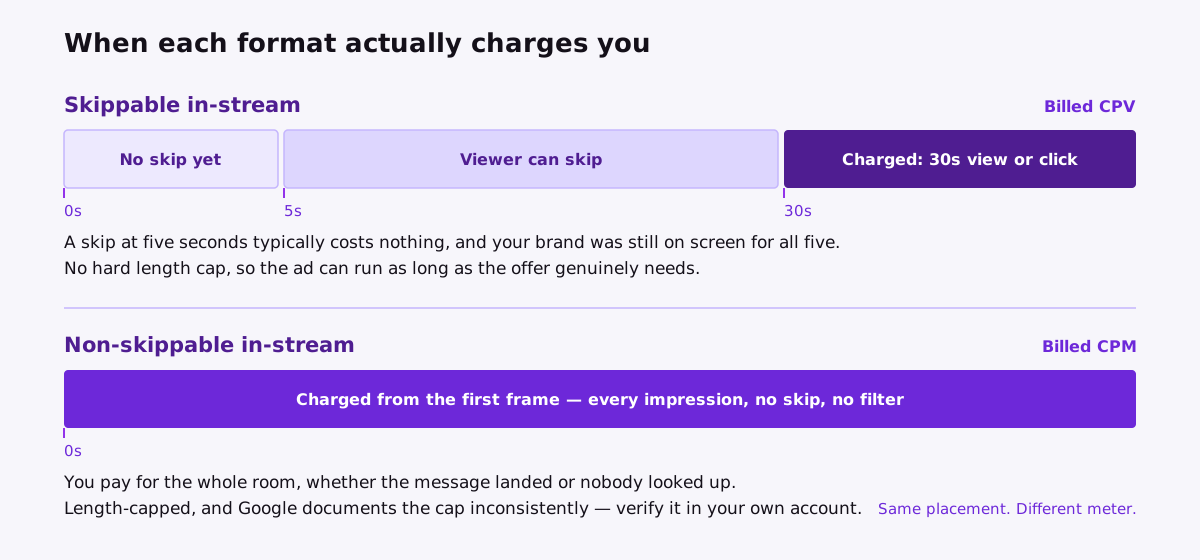
A skippable in-stream ad plays before or during someone else's video, and the viewer can skip after five seconds. In its classic setup you are billed on a cost-per-view basis: you pay when someone watches 30 seconds, watches the whole ad if it is shorter than 30 seconds, or clicks it. Someone who hits skip at second five typically costs you nothing.
A non-skippable in-stream ad occupies the same placement with no escape hatch, and it is length-capped — though the cap has moved and Google's own documentation is not consistent about it. The Google Ads help centre says 15 seconds or less while the YouTube help centre says 60 seconds or shorter, so check the limit in your account before you cut to a number. Billing is CPM, cost per thousand impressions. You pay for every person the ad is served to, whether the message landed or they spent the whole ad looking at their notifications.
| What you are buying | Skippable in-stream | Non-skippable in-stream |
|---|---|---|
| Skip | Viewer can skip after five seconds | No skip at all |
| Length | No hard cap — 60 or 90 seconds is allowed | Capped, and Google documents the cap inconsistently. Verify it in your account |
| Billing | Usually CPV, cost per view | CPM, cost per thousand impressions |
| What triggers a charge | A 30-second view, a full view of a shorter ad, or a click | Every impression served |
| Cost of a skip at second five | Typically nothing | Not applicable — you have already paid for the impression |
Read that as pricing rather than as formats. With skippable, the audience filters itself and you pay for the survivors. With non-skippable, you pay for the whole room and buy guaranteed completion in exchange.
That is the trade. Not "can they leave" but "who am I paying for".
Why skippable ads suit direct response
If you are selling something that needs explaining — a course, a consultation, a considered purchase, anything where the decision takes more than a slogan — skippable in-stream is the only format that gives you both the room and the filter.
The room matters because there is no hard length cap. You can run 60 or 90 seconds if the offer genuinely needs it. The filter matters more. Everyone who is still watching at second 30 has made an active decision to keep watching an advertisement, which is a considerably stronger signal than anything you can buy with targeting.
It also changes what your creative has to do. Your first five seconds are not a stylistic choice, they are your cost structure. A weak opening does not just lose viewers, it loses the right viewers and keeps the wrong ones — the people half-watching who never got around to skipping. If the offer is not clear by second four, you are paying to be watched by people who have no idea what you sell.
Why non-skippable suits awareness and almost nothing else
Non-skippable earns its place when the message is genuinely short and the goal is recall rather than a response you can count. A launch. A sale window with an end date. A category message you need drilled into a defined audience at a known frequency. In those cases guaranteed completion is a real product and CPM is a fair way to buy it.
Where it fails is as a direct-response format, and it fails for a reason worth stating plainly: a captive audience is not an interested one. Forcing a 15-second pitch on someone who would have skipped at five does not turn them into a better prospect. It produces a completed view and no intent, and you paid full price for it.
There is also a creative constraint people underestimate. Fifteen seconds is not a short version of your 60-second ad. It is one idea, delivered once. If your message needs a sentence of setup before it makes sense, non-skippable is the wrong buy regardless of objective.
TrueView, and why the name keeps confusing people
If you learned YouTube advertising before roughly 2023, you learned it as TrueView. Google has largely retired that branding in favour of plainer names. The names on the interface changed; the auction underneath did not.
| The TrueView name | What it is called now |
|---|---|
| TrueView In-Stream | Skippable in-stream — the skippable format, unchanged underneath |
| TrueView Discovery | In-feed video — the thumbnail ad in search results and the watch-next column |
| TrueView for Action | Absorbed into Demand Gen — the conversion-focused variant with the button and the form |
This matters practically, because a lot of the advice still circulating online is written in the old vocabulary and refers to campaign settings that have been renamed, merged into Demand Gen, or moved. Treat any TrueView-era tutorial as directionally useful and structurally out of date, and check the current setup flow before you copy a build from it.
TrueView for reach is the exception that proves the point
There was one variant worth pulling out separately, because people still search for it by name: TrueView for reach.
It served a skippable in-stream ad — viewers could still skip at five seconds — but billed on CPM instead of CPV and optimised for reach rather than views. Skippable creative, non-skippable pricing.
That combination is the clearest proof that the skip button and the billing model are separate decisions. You can buy a skippable placement on a CPM basis. What changes is not the viewer's experience, it is what you are paying for and therefore what the system optimises toward. On CPV, Google works to find people who will watch. On CPM, it works to find cheap impressions.
The functionality now lives inside reach-focused video campaign settings rather than under that name, and the exact labels have moved more than once. If you inherited an account with old campaigns, this is one to check rather than assume.
So which one should you run
For most advertisers reading this, skippable. Not as a hedge — as an answer.
If you have a conversion to point at, a lead form, a purchase, a booking, or an enquiry, skippable in-stream is the format that lets you qualify the audience and hold the ones who qualify long enough to explain something. It is the workhorse. Start there, and make the first five seconds carry the offer.
Run non-skippable when three things are true at once.
- The objective is recall rather than response
- The message fits inside the length cap without compression
- You have a defined audience you want to hit at a controlled frequency
If any of those is missing, you are buying completed views because they feel like value, not because they produce anything.
What this looks like in an Indian account
CPMs on YouTube in India typically sit well below what advertisers pay in the US or UK, which cuts both ways. Reach is genuinely cheap, so non-skippable and bumper inventory is affordable at volumes that would be out of reach in a Western market. That affordability tempts people into buying reach they cannot convert.
Cheap views are not the constraint here. Attention is, and skippable pricing is the only one of the two that makes you pay for it. When impressions are inexpensive, the discipline of only being charged for people who chose to stay is worth more, not less.
The other Indian-market factor is language and creative length. A skippable ad gives you room to run a message in the language the audience actually thinks in and still explain the offer. Squeezing that into 15 forced seconds usually means cutting the part that does the persuading.
What we actually run
- 1
Start with skippable in-stream carrying the real message
For nearly every account we take on, the YouTube plan starts here, with a first five seconds built to state the offer rather than set the scene. That campaign does the work of finding who is interested and proving whether the offer converts at all.
- 2
Bring non-skippable in later, against a warm audience
It is usually not a prospecting layer. Where it earns its budget is against a warm audience during a defined window — a launch, an enrolment deadline, a sale — where you want a short message to land completely across people who already know the brand.
- 3
Test a bumper before committing to 15 seconds
Bumpers at six seconds often do that job more cheaply, which is worth testing before you commit to the longer non-skippable buy.
The question we ask before signing off on any non-skippable buy is simple: would this audience have skipped? If the honest answer is most of them, then you are about to pay for the ones who would have left. Sometimes that is exactly what you want. Usually it is not.
Common questions
Are bumper ads the same as non-skippable ads?
They are a separate six-second format that also cannot be skipped and is also bought on a CPM basis, so the same logic applies: you pay for everyone the ad reaches. This article is about non-skippable in-stream specifically. Where the message genuinely fits in six seconds, a bumper is usually the cheaper way to buy guaranteed completion, which is why it is worth testing before committing to a longer non-skippable buy.
Does any of this apply to YouTube Shorts ads?
No, and that is the point worth knowing. Shorts is a vertical feed placement where the viewer can swipe away from the first frame, so there is no protected five-second window and no non-skippable equivalent to buy. The skippable-versus-non-skippable decision described here is an in-stream decision. Shorts is a separate planning question about vertical creative and how the feed is bought.
What if I do not have conversion tracking set up yet?
Fix that before choosing a format. The argument for skippable rests on being able to see what the qualified viewers did next, and without tracking you are left judging either format on views and completion rates, which is exactly the mistake this article warns about. Get the conversion action firing and verified first, then run skippable in-stream and let the numbers settle the format question for your account.
Want someone to run this for you?
We plan, build, and manage YouTube ad campaigns end to end — formats, targeting, creative, and retargeting. Google Premier Partner.
See our YouTube advertising services